
Therapy for Anxiety, Stress & Confidence.
Psychological support for adults navigating anxiety, overwhelm, stress and issues around confidence.
I work with adults who are struggling with anxiety, stress or feeling overwhelmed by the demands of life.
Many of the people I see appear to be coping well on the outside but privately contend with overthinking, perfectionism, performance anxiety, burnout or feeling like they've lost confidence in themselves.
From the outside, you may be the reliable one, managing a great deal of responsibility across work, family and your own expectations of yourself. Internally, the picture can be very different.
You might recognise:
A mind that rarely settles. A sense of being on alert even when nothing is wrong, and finding it difficult to rest without something pulling your attention.
Confidence that does not match your competence. Second-guessing yourself under pressure, or feeling that your success has more to do with effort than ability.
Depletion that sleep does not fix. Giving your best energy to work and to other people, only to find there is little left for yourself.
These are not character flaws. This often happens when you have been carrying more than you currently have room for. These difficulties are often invisible to everyone around you. Over time, they can narrow your focus, erode your confidence, and quietly cost you more than they appear to.
Something to start with
If what you have just read feels familiar, you do not need to wait for a first session to begin.
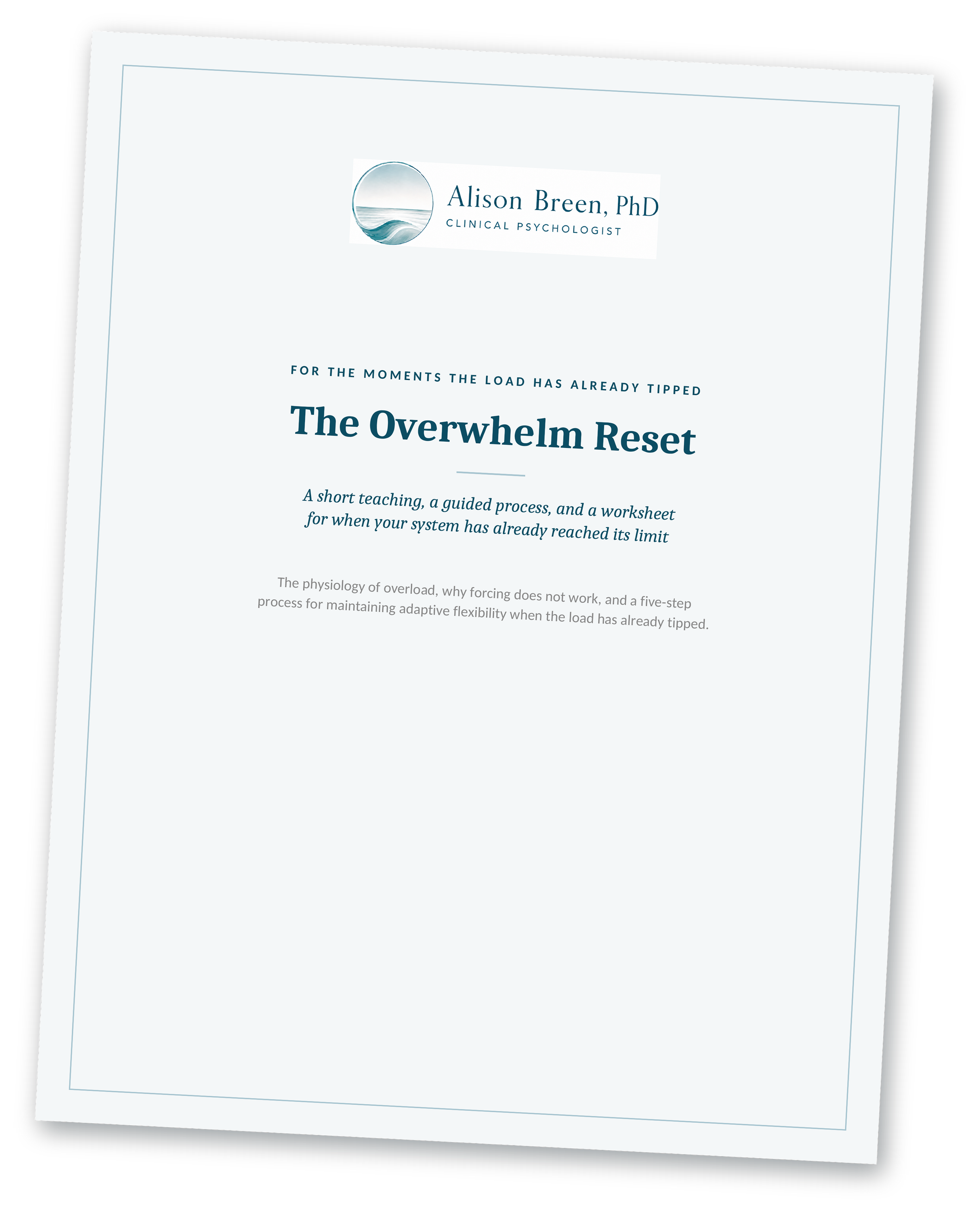
The Overwhelm Reset is a short teaching and guided process for moments when your system has already tipped: the freeze, the fog, the wall you cannot explain. It walks through the physiology of what is happening, why forcing your way through does not work, and a five-step process to find your way back: notice, soften, allow, find safety, one small step. Includes a printable worksheet.
My Approach
Anxiety and self-doubt are rarely the whole story. They are often the visible edge of patterns that developed for good reason, sometimes long before they became a problem.
So rather than working only at the level of symptoms, therapy with me is an opportunity to understand what is underneath and develop new ways of responding. My practice is grounded in psychodynamic and attachment-informed work, which means we look at your history, your relationships and the patterns you have carried, with curiosity rather than judgment. When distressing or unresolved experiences are part of the picture, I also work with EMDR.
My thinking is also strongly shaped by Acceptance and Commitment Therapy (ACT), compassion-focused approaches and research on emotion regulation.
The aim is not to become a different person or to eliminate anxiety. It is to understand yourself more accurately, relate to difficult experiences differently, and develop greater trust in yourself. Over time, this can build a steadier kind of confidence: the capacity to stay present, make choices and respond effectively when life is difficult or uncertain, even when anxiety or self-doubt are still there.
About Alison
I am a Clinical Psychologist with more than eighteen years of experience, and a longstanding interest in the impact of stress on the mind and body, dating back to my first degree in physiology and psychology. I work with adults experiencing anxiety, self-doubt, overwhelm, chronic stress, relationship and leadership challenges, and life transitions, online and in person.
Throughout my career, I have been drawn to how our experiences shape the way we think, feel, relate and respond, and to what happens when we carry too much for too long. Anxiety, overwhelm and self-doubt are among the common reasons people come to therapy, and they often make more sense once you understand the patterns that developed in response.
Alongside my clinical practice, I completed a PhD exploring resilience, relationships and children's development in contexts of adversity in South Africa. That research deepened my interest in adaptive flexibility: our capacity to stay in contact with ourselves and respond effectively when life is difficult or uncertain. It also strengthened my conviction that relationships and environments matter enormously in how well any of us cope.
This has led to a particular interest in confidence and self-trust, not as the absence of doubt or difficulty, but as the ability to stay present, make choices and trust yourself to respond when life does not go according to plan.